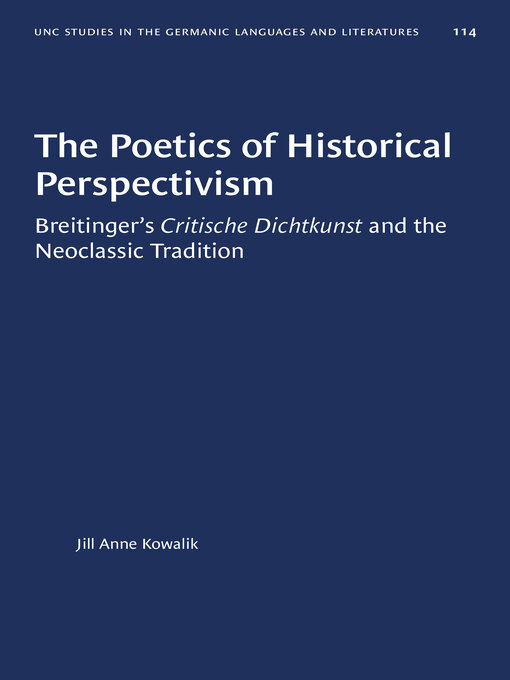
Jill Kowalik reevaluates J. J. Breitinger’s Critische Dichtkunst (1740) with regard to a heretofore neglected aspect of aesthetics in the early eighteenth century, namely how poesis and historiography could increasingly come to resemble each other in their assumptions, purposes, and methods of representation. The central argument states that historians of this period began to utilize the concept of historical perspectivism only after its development as an interpretive tool by the aesthetic thinkers of the early Enlightenment.
The Critische Dichtkunst is examined in terms of three disparate traditions: the modern reception of Aristotle’s Poetics, Horace’s Ars poetica, and the Quarrel between the Ancients and the Moderns; the model of consciousness proposed by Leibniz that describes the mind as a ceaseless process of historical intellective integration; and the German reception of French neoclassical authors, especially Dubos, whose notion of historical probability was radicalized by Breitinger and later appropriated by poets and historians alike.
- Climate Fiction Prize 2025
- Book Day 2025
- Earth Day
- English Language Day
- 2025 UK Summer Reading Challenge
- Freemium Bookshelf
- British Science Fiction Association awards
- Book of the Year
- International Booker Prize
- 2025 Women's Prize for Nonfiction
- The Arthur C. Clarke Award
- Uplifting Reads to Kickstart Your Year
- Bestsellers of 2024
- See all ebooks collections
- Self-improvement audiobooks
- World Read Aloud Day
- Audiobooks
- Author of the month - Beatrix Potter
- See all audiobooks collections
- World Cancer Day
- International Day of Women and Girls in Science
- Magazines
- World Photography Day
- See all magazines collections