New Scientist covers the latest developments in science and technology that will impact your world. New Scientist employs and commissions the best writers in their fields from all over the world. Our editorial team provide cutting-edge news, award-winning features and reports, written in concise and clear language that puts discoveries and advances in the context of everyday life today and in the future.
The floodgates are open • The AI age has unleashed a torrent of text – dealing with it won’t be easy
News
Hack your productivity • An endless stream of distractions in our busy world can make focus slip away, so Helen Thomson went hunting for neuroscience-backed ways to boost your productivity
AI refuseniks • There is no question that AI has transformed mathematics in recent months. Jacob Aron wonders if it will soon be impossible to reject AI and continue working in the field
Pond life
Book of the week
On board the AI rollercoaster • Despite disagreeing over when (or if) AI will achieve human-level intelligence, Jacob Aron thoroughly recommends this primer to a fast-moving field
Save the cheerleader, save the world • Sci-fi show Heroes, about ordinary people with extraordinary genes, first aired 20 years ago. Its first season is almost perfect, a combination of compelling characters, imagery and music, says Bethan Ackerley
Your letters
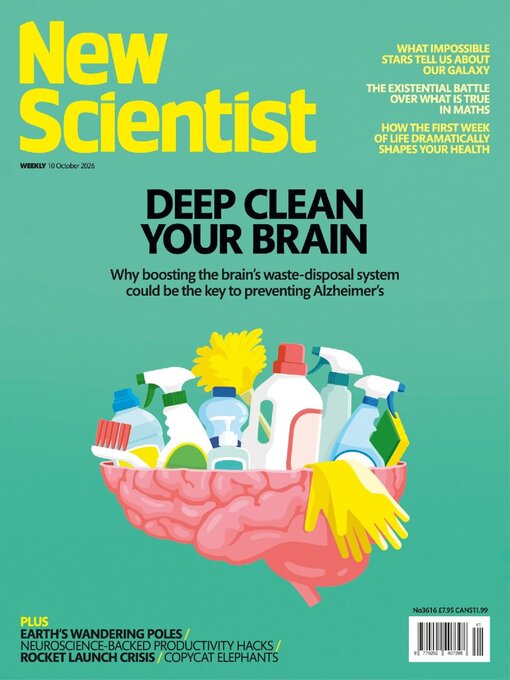
How to clean your brain • Boosting the brain’s system for flushing out toxins could help protect your brain health – and possibly even prevent Alzheimer’s, discovers Michael Marshall
Written in the stars • A swarm of stars that hurtles around the supermassive black hole at the centre of the Milky Way could be the key to understanding our galaxy, finds Leah Crane
"There is a gradient between definitely not extinct, definitely extinct and everything in between" • Finding that long-lost plants and animals are still alive often isn't an unmitigated cause for celebration, says evolutionary biologist Aelys Humphreys. She tells Penny Sarchet that to get to grips with the true scale of species loss, we need to completely change how we think about extinction
Almost the last word
Feedback